• How many gods are there?

    Well that depends who you ask – for example:

    • Monotheistic Religions – such as Christianity, Islam, and Judaism believe in one God.
    • Polytheistic Religions – both ancient and some modern religion (including Hinduism, ancient Greek, Roman Egyptian and Norse religions) had / have multiple gods.
    • Philosophical / Atheistic Views – some philosophies and atheistic world views reject the existence of any gods at all.

    Certainly if you were to add up the total of all gods people believe in (and no longer believe in) it would run into thousands.

    Some people believe (or believed) there are many gods – some just one. A person who believes in one god will typically disbelieve someone who worships another god – claiming their god is the one ‘true’ god. And vice versa – logically they cannot bother be right – but they can both be wrong!

    A humanist accepts there is no actual evidence for any gods or goddesses – they were invented to explain the world around them until and it has been said that the reality may actually be “man made god not god made man”.

  • Is humanism a religion?

    Humanism is typically not considered a religion. It is seen as a philosophical or ethical outlook – emphasising morality, human dignity, reason and the value and agency of human beings both individually and collectively.

    Humanism normally rejects religious doctrines, supernatural beliefs, and dogmatic authority, focusing instead on rational thought, scientific inquiry, empathy, and secular ethics as guides to improving human life and happiness.

    However, there are some distinctions:

    Secular Humanism – is how it is most often understood – is explicitly non-religious, emphasising reason, science, secular morality and the separation of church and state. Considered a non-religious philosophy or worldview.

    Religious Humanism – incorporates humanist ethical values and principles into religious structures or communities, sometimes including ritual or communal practices. Examples include Humanistic Judaism, some Unitarian Universalist congregations and Ethical Culture societies. But even here any beliefs in supernatural elements tend to be minimal / symbolic with greater emphasis on ethics and community instead of traditional religious doctrines.

    From a ‘legal’ perspective sometimes humanism is recognised as a religion for legal purposes (such as First Amendment protections) to help ensure equal rights and protections under the law.

  • What gives your life meaning?

    Some people believe meaning comes from a ‘god’ or higher power – but without evidence. Instead for many people meaning actually comes from:

    • Relationships and Love – connections with family, friends and a partner provides a sense of belonging.
    • Growth and Learning – personal development, education, and self-improvement provide a sense of purpose.
    • Purpose and Contribution – whether through work, creative pursuits or helping others can give life meaning.
    • Spirituality and Philosophy – some find meaning in religious beliefs, meditation, or philosophical exploration of existence.
    • Experiences – finding happiness in the small moments, nature, art, travel, nature or hobbies and interests makes life rich and meaningful.
    • Legacy and Impact – making a difference, leaving something behind – whether that is through children, ideas, kindness or other legacy – can give life deeper significance.
    • Resilience and Struggle – overcoming challenges / hardships often brings wisdom, gains experience and a greater appreciation for life.

    A humanist believes meaning comes from your experiences, your family / friends, emotions, ambitions and goals in life. Learning, sharing knowledge, making life a bit easier, more interesting and perhaps a little more fun.

  • What do you think when you see the Earth and all its natural beauty?

    Some think it must have been designed by a designer God? A humanist is more likely to think it was formed by a series of natural processes over millions and billions of years and that we need to protect it so future generations can also appreciate it.

    A humanist sees the Earth and its natural beauty and it inspires an appreciation for humanity’s connection with the natural world. It evokes a sense of responsibility to protect the planet – not because of divine command – but because preserving Earth’s beauty and sustaining its ecosystems contributes to human well-being, happiness, and fulfilment.

    The Earth symbolises our common humanity, emphasising the importance of cooperation, compassion, reason, and stewardship. Its beauty highlights how deeply our physical and emotional well-being depends upon nurturing our environment – and each other.

    The awe inspired by Earth’s natural beauty and splendor reinforces a humanist commitment to reason, science, and ethical responsibility. It calls us to pursue sustainability, social justice, and environmental protection as moral goals grounded in empathy, reason, and concern for the flourishing of human life.

  • What happens to you when you die?

    There are varying spiritual and religious beliefs – including:

    • Christianity, Islam, Judaism (the Abrahamic faiths) – teach that the soul leaves the physical body at death and moves on to an after-life – heaven, hell, or resurrection.
    • Hinduism and Buddhism – typically emphasise reincarnation where consciousness or karma continues in a new form or being.
    • Spiritualism / other New Age Beliefs – suggest consciousness survives physical death continuing in spiritual dimensions or other forms of existence.

    Although many people would like to believe in some sort of afterlife or rebirth. Many just assert an afterlife based on scripture, spiritual experiences and faith.

    Humanists do not share these beliefs as there is no evidence for them. Instead they would want to remember those who died and use this to live their own lives fully, find meaning and happiness.

    A humanist believes when they die that is the end of them – so they live this life as if it is the only one they have.

  • Were the Earth and Universe created as part of a divine plan?

    Many religious people are told to believe it came into existence around 6000 years ago.

    But science and a humanist would take time to understand the science and evidence that it is a natural place formed over billions of years.

    Radiometric Dating is done using carbon dating for more recent samples and other isotopes (like uranium – lead) for older samples / rocks. It measures the decay of radioactive elements over time. Using these methods the age of the Earth has been estimated to be about 4.5 billion years old.

    Evolutionary Biology using the fossil record shows evidence of life forms having evolved over billions of years. Starting with simple micro-organisms to complex animals. The evolution of these organisms takes vast amounts of time. The oldest known fossils of single-celled organisms date back about 3.5 billion years. More complex organisms, such as plants and animals, evolved over hundreds of millions of years, reflecting the long history of life on Earth.

    Ice Cores taken from Antarctica and Greenland contain annual layers that can be counted back in time. Some of these ice layers have been dated to over 800,000 years.

  • What makes something true?

    The concept of truth is complex and can be approached from philosophical, logical, and practical perspectives. Generally, something is considered as being “true” when it accurately reflects reality or corresponds to facts.

    Some people think truth is subjective and their opinion – so something can be ‘true for them’. But that is not truth – truth is objective and absolute.

    You may believe something is true if you read it in a sacred text or were told it by a religious leader. Christianity even says you are blessed if you believe without evidence

    A humanist is more likely to believe something is true if they have seen the evidence themselves (or from a trustworthy source) and can judge it to be valid and accurate.

  • What is humanism?

    Humanism is system of thought focussing on humans and their welfare, needs and values – humanity. 

    It is an ethical point of view that emphasises the dignity and worth of individual people and rejecting claims of the supernatural.

    It stresses the need for people to achieve improvement of society and self-fulfillment through reason and to develop human-oriented ethical values without the divine / supernatural.

    The Core Ideas of Humanism:

    • Reason and critical thinking – not just relying on tradition or authority.
    • Human dignity and worth – all humans possess inherent value deserving ethical treatment and respect.
    • Empathy and compassion – advocating compassion, respect and kindness, compassion for others.
    • Universal human rights – equality, justice, freedom, social responsibility.
    • Secular ethic – believing morality comes from human experience, logic and rational thought – separate to religious doctrines.
    • Human creativity / culture – encompassing philosophy, science, art, literature as expressions of human potential.
  • Who are humanists?

    Humanists identify with or advocate the philosophical and ethical stance of humanism – including:

    • Science / scientific method and critical thinking as reliable ways to understand the world
    • Empathy and compassion – not dogma or tradition
    • Logic and reason – not superstition
    • Secular ethics for human well-being
    • Human rights and social justice for all

    A humanist is someone who believes in making the most of this life – as they believe it’s the only one they have. Believing you can be ‘Good without God’ and treating others as they would like to be treated – with love and respect and promoting co-operation towards a better future for all.

    Looking at the world with scientific enquiry, critical thinking, logic and evidence – not supernatural belief and dogma. Acknowledging that the evidence shows the Universe is a natural phenomenon and man originated by evolution.

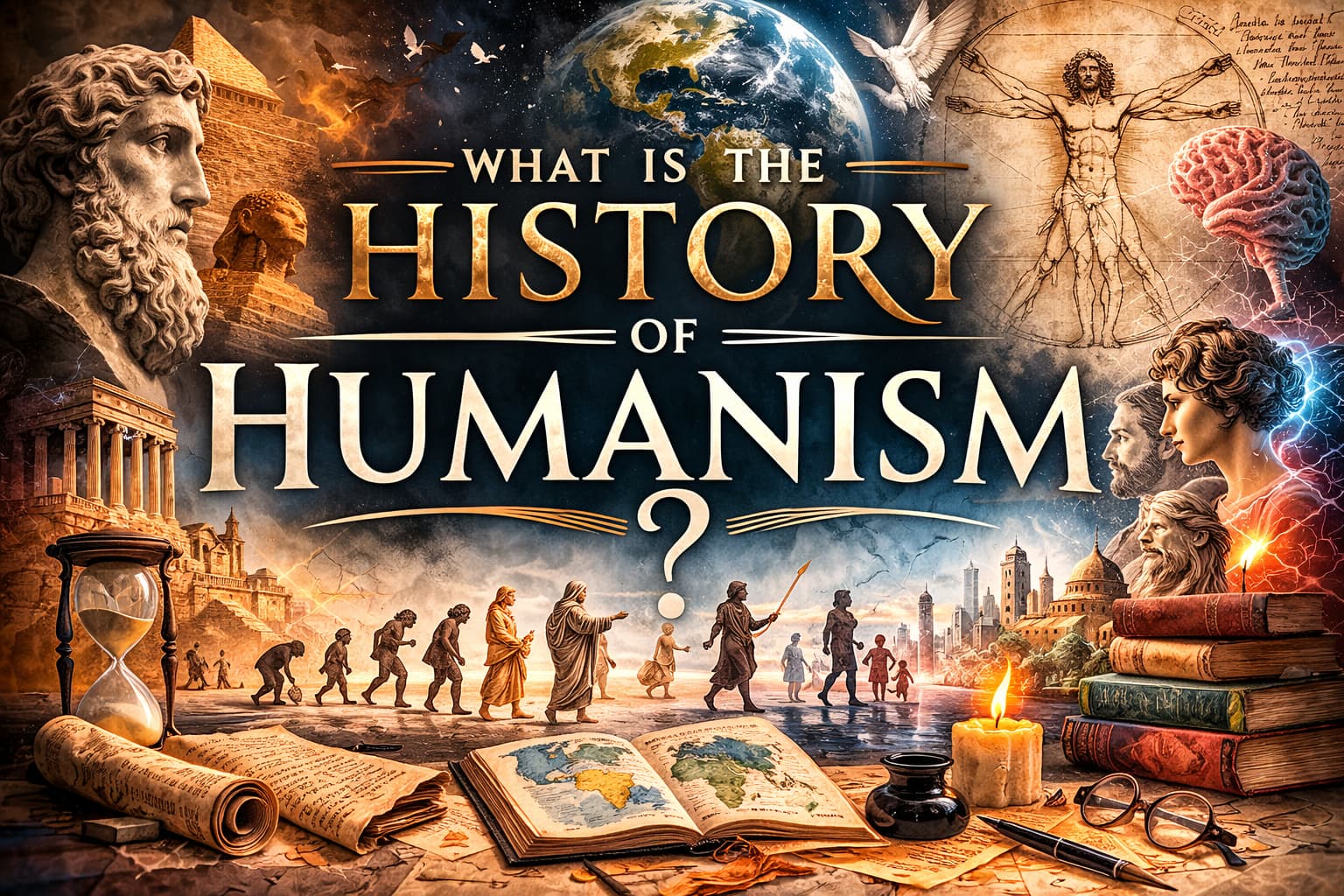
  • What is the history of humanism?

    Classical Roots – Humanism had its earliest roots in ancient Rome and Greece.

    Greek Philosophy – Thinkers like Socrates, Plato and Aristotle emphasised ethics, reason, moral development and the pursuit of knowledge for human flourishing.

    Roman Humanitas – In ancient Rome, Cicero popularised the term humanitas – meaning “human nature” “civilised behaviour” or “education” – encouraging ideals like dignity, virtue and the importance of studying history, language and philosophy to cultivate moral character.

    Renaissance Humanism emerged in Europe in the 14th to 17th centuries as a cultural and intellectual revival of classical Greek and Roman learning. Humanism arose in Italy (14th century) inspired by figures such as Petrarch and Giovanni Boccaccio who rediscovered classical texts and promoted secular scholarship.

    During this period there was emphasis on human dignity, history, philosophy, art and the study of classical literature as ways to understand humanity and live virtuous, fulfilling lives. Renaissance humanism has helped shape education, politics and science and laid the foundations for modern ideas around human rights and secular values.

    Enlightenment Humanist – In the 17th and 18th. centuries important writers, philosophers and thinkers like John Locke, Voltaire, Jean-Jacques Rousseau and Immanuel Kant further developed humanist thought.

    The Enlightenment prioritised the scientific method, individual freedom, rational inquiry and questioned religious authority and dogma.

    Over time the meaning and usage of the term “humanism” has broadened. It came to represent a worldview that places a high value on human dignity, autonomy and self-determination. Modern humanism stresses rational thought, empirical evidence and ethical considerations based on human welfare rather than supernatural beliefs.

    In modern usage the word “humanism” has evolved from its classical origins to describe the powerful concept that celebrates the potential and worth of human beings across all areas of life.

  • Where does the word ‘humanism’ come from?

    The word humanism originates from the Latin word humanitas meaning ‘human nature’ ‘civilisation’ or ‘kindness’ which itself is derived from humanus meaning ‘of man’ or ‘human’.